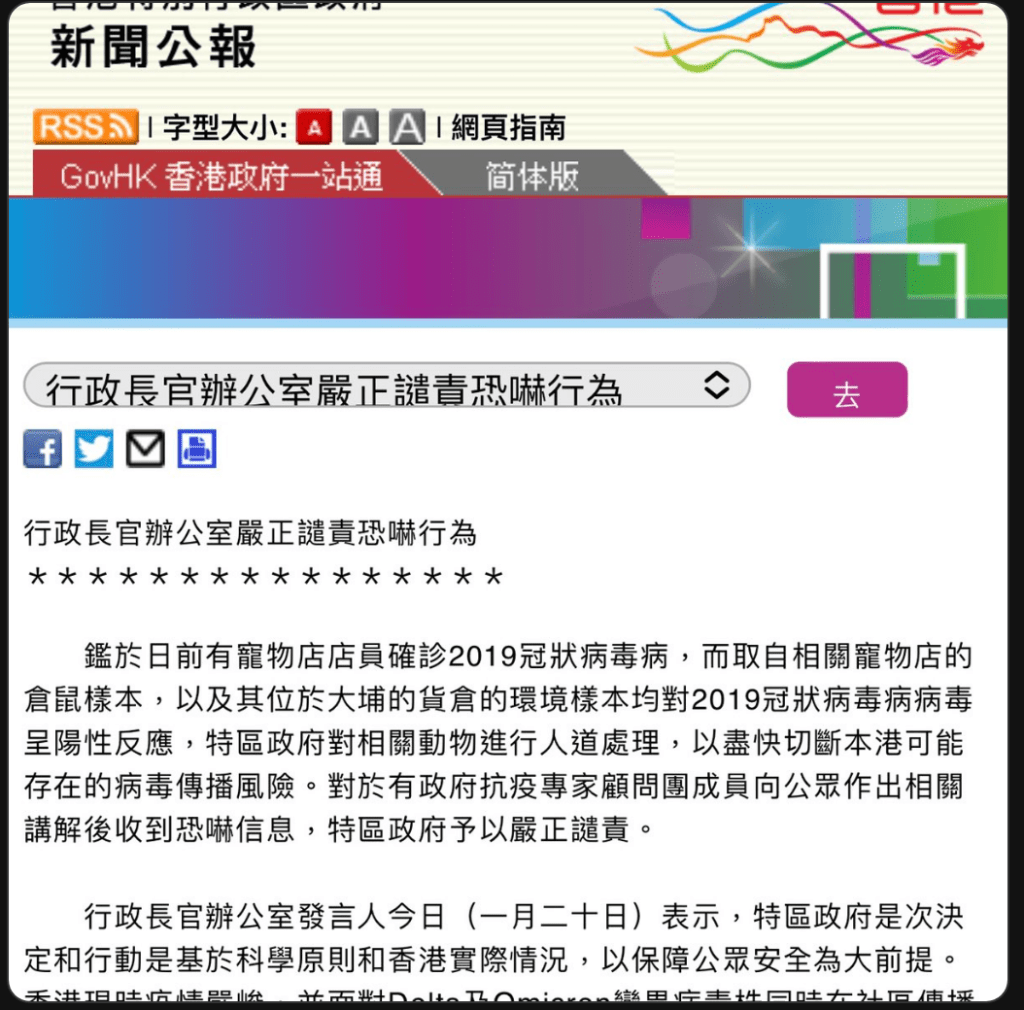
Hong Kong has ordered thousands of hamsters be surrendered for “disposal” after traces of Covid-19 were found on 11 animals in a pet shop.
[…] Authorities announced on Tuesday that traces of the virus were detected on 11 hamsters out of 178 hamsters, rabbits and chinchillas tested at the Little Boss pet shop and associated warehouse in Causeway Bay while investigating the city’s first untraceable Delta variant diagnosis in more than three months, in a 23-year-old store employee.
Two employees were also confirmed to have the disease, including one who cleans out the animal cages and handles the hamsters.
In response, they ordered the immediate suspension of hamster sales and imports of all rodents. An estimated 2,000 hamsters, including any bought since 22 December, must be handed over, local media reported, and the owners must report for testing. [Source]
Officials forced all 35 licensed pet shops that sell hamsters in Hong Kong to temporarily close, and executed a mass culling. The subsequent order for pet owners to hand over their hamsters applied only to those who purchased them on or after December 22, when a local pet shop received a batch of hamsters from the Netherlands, an alleged source of the COVID-19 contamination. The order was not mandatory, but officials described it as a “strong recommendation” that could have consequences if unheeded, prompting over one hundred pet owners to relinquish their hamsters. Spooked by the news, some even handed over hamsters that had been purchased months ago. Among the 104 hamsters surrendered to the government, only one tested positive for the virus.
One owner — who bought her pet on Jan. 1 — reacted in defiance.
“No one can take my hamster away unless they kill me,” she told the Standard newspaper yesterday.
She pushed back on the government’s mass cull, recalling a recent birthday party attended by officials that resulted in multiple COVID-19 infections and left Hong Kong’s leadership red-faced.
“Will they also kill all infected COVID-19 patients and their close contacts?” she said. “If all people who attended the birthday party are culled then I will hand my hamster to the government.”
A grim humor settled on Hong Kong-centric social media accounts, with people publishing illustrations of hamsters wearing surgical masks or facing off against the Grim Reaper. [Source]
Within a day of the government announcement, over 11,000 people signed a petition calling on authorities to stop the hamster cull. Animal rights groups urged people not to surrender their hamsters in compliance with the government order, arguing that hamsters are legally considered personal property and cannot be taken away unless voluntarily given up. Some highlighted hamsters’ elevated moral status as companion animals, in contrast to livestock such as chickens, to demonstrate the ethical offense of culling them in the name of epidemic prevention. Shibani Mahtani and Theodora Yu from the Washington Post described how defiance turned into active resistance:
Resistance groups have assembled on the Telegram messaging app to share updates, drawing on methods used in anti-government protests in 2019. Nearly 3,000 people have volunteered to house the affected hamsters. On social media, concerned residents have shared photos of abandoned hamsters in the hope of enlisting rescuers. Many garnered responses in seconds.
[…] For many pet owners, the response [to the cull] was a resounding “no.” Alice, 36, said she would never turn in Siu Ding, purchased from Little Boss for her 6-year-old daughter after the cutoff date. She spoke on the condition that only her first name be used, for fear that the authorities could trace the pet.
“Their sins are too deep,” she said, referring to the government as she held back tears. “I don’t want my hamster killed.”
[…] Hamster supporters are mobilizing in creative ways. One, who is skilled in Photoshop, has offered to amend hamster purchase receipts to indicate the pets were bought before Dec. 22.
[…] “I told my mother, ‘I won’t throw you out if anything happens to you, as you are my family. Same goes for my hamster; it is my family,’ ” [a woman with the last name Yuen] said, withholding her full name out of security concerns. [Source]
The NFT project, called Carries Hamsters – named after Hong Kong leader Carrie Lam – was launched on Thursday as hamster owners in the city started dropping off their pets at a government facility.
“We will not stand for the euthanising of our little hamsters,” read an Instagram post from the team announcing the project on Thursday. “To stand up, spread [the] word and positivity – 2,000 hamsters will be resurrected on the Solana blockchain with proceeds being directly donated to an animal charity combating the euthanising of animals,” the post said. The group’s profile specifies that only part of the proceeds will be donated to local charities. [Source]
With the city’s zero-Covid regime leading to soaring cargo rates and flight cancellations, people are grouping together to use private jets at a cost of about HK$200,000 ($25,665) for each owner with their pet, companies and individuals say.
[…] Steve Pheby, a senior consultant at Ferndale Kennels and Cattery, said that before the pandemic his business was usually evenly balanced between importing and exporting pets, but it was now 90-95 per cent based around exports. […] He noted it could cost up to HK$150,000 to transport a Labrador and its owner to the UK. [Source]
Thousands of people have offered to adopt unwanted hamsters amid a public outcry against the government and its pandemic advisers, which the office of Hong Kong leader Carrie Lam called irrational.
The Agriculture, Fisheries and Conservation Department (AFCD) said any effort to try to save hamsters would be dealt with, even if that meant calling in the law.
“If the people concerned continue with such action, or fail to return the hamsters taken away, the AFCD will stringently follow up and hand it over to the police for handling,” said the department, which has also advised people not to kiss pets. [Source]
Much of the criticism stems from the government’s flimsy scientific justification for the cull. The U.S. Centers for Disease Control and Prevention have stated that there is “no evidence” that animals play a significant role in spreading the virus, and City University of Hong Kong’s Center for Animal Health and Welfare said the risk of contracting the virus from pets is “negligible.” (As mobilizers have pointed out, hamsters are stuck in their cages, so it is often humans that spread the virus to hamsters in the first place.) Moreover, findings from a study by Hong Kong University’s medical school in the journal “Nature” show that “golden hamsters would stop shedding the virus through respiratory secretions after six days of isolation,” indicating that quarantine might have been a safe alternative to execution.
But across the border, it was business as usual. As of Wednesday, hamsters were still being sold at the Shenzhen-based Rabbit Mall shop, affiliated to Hong Kong-based franchise Pet-Link.
[…] Shops on e-commerce platform Taobao, owned by the Post’s parent company Alibaba, also continued to sell hamsters.
The Post checked with at least 10 shops listed on the platform selling breeds including the popular Syrian hamster, all of which indicated that their hamsters were bred domestically and not imported. [Source]
Granted, the hamsters in mainland China are local breeds, unlike those imported into Hong Kong from the Netherlands. But local governments in China have previously cracked down hard on pets in their anti-pandemic purges. Last fall, after videos surfaced of health workers infiltrating households to beat dogs and cats to death, some local authorities attempted to justify the actions by suggesting that the virus could spread from pets to humans. Hong Kong’s hamster-harvesting policies may have been inspired by Beijing: a mere day after central government authorities began propagating their recent and highly dubious theory of COVID-19 transmission via international mail, Hong Kong began rounding up its hamsters.


 China New Era
發表留言